Description
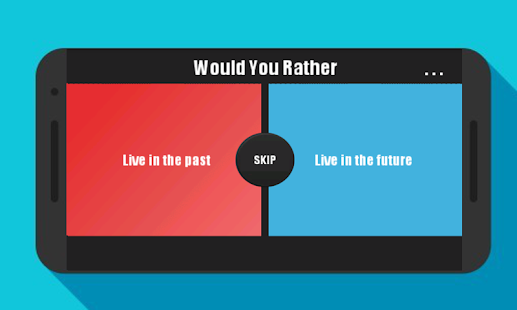
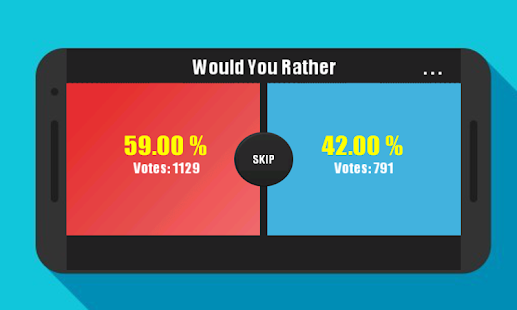
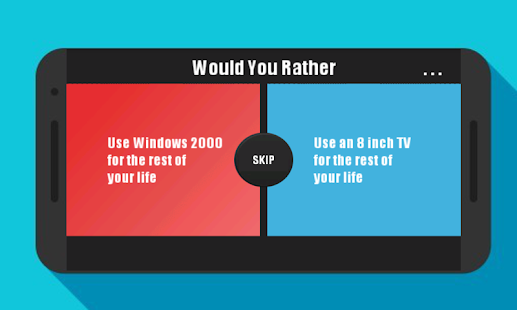
"Would You Rather?" is a classic party game that usually revolves around players being faced with two equally challenging, humorous, or intriguing scenarios, and having to choose between them. It's a simple concept but can lead to deep insights into personalities, humor, and thinking processes, turning any gathering into a lively and engaging experience. The game is notable for its versatility, requiring nothing more than a group of willing participants and some creative questions. Often played as an icebreaker, "Would You Rather?" can adapt to any age group or social setting, making it a favorite for both casual get-togethers and more structured events. The goal is not about winning or losing, but about having fun, generating laughter, and sparking conversation. Despite its simplicity, "Would You Rather?" is renowned for its ability to foster deeper connections and understanding among its players.
Read more
How to Play
The game of "Would You Rather?" is quite straightforward yet infinitely flexible, allowing it to be customized to suit any event or group dynamic. To play, gather your group of friends, family, or strangers. It usually works best with at least three people but can scale to accommodate larger groups. The basic premise involves one player posing a question that starts with "Would you rather," followed by two scenarios. These scenarios can range from the mundane, such as "Would you rather have spaghetti for hair or marshmallows for feet?" to the profound, like "Would you rather have the ability to fly or be invisible?"
The real charm of "Would You Rather?" lies in the creativity of the scenarios posed. Questions can be pre-prepared or improvised on the spot, depending on the mood and the participants' creativity. Some players might enjoy absurd, humorous options, while others might go for deeper, more philosophical choices. This versatility is what allows the game to be played in different settings, whether it's a light-hearted family gathering or a more intense, philosophical discussion among friends.
To start the game, a player volunteers or is chosen to be the first questioner. This player presents a "Would you rather" question to another participant or the group. Players then have to choose between the two options presented, often after much deliberation if the choice is difficult. While there isn't a strict time limit on choices, introducing one can add an element of pressure that makes the game more interesting. After a player answers, the reason behind their choice can spark conversations, debates, and banter, providing insight into their thought processes and preferences.
One key element that adds to the fun is the rule that participants must choose one of the two options. Sitting on the proverbial fence, or opting for "neither" is generally against the rules unless agreed upon before play begins. For added engagement, the person answering can be encouraged to defend their choice, leading to lively debates that showcase each player's personality and convictions. This can be particularly amusing when extraordinary or illogical scenarios are in play.
For those looking to structure the game, dividing it into rounds where each player gets a chance to pose a question ensures everyone stays engaged throughout the session. Additionally, thematic variations of the game can be introduced, such as a "zombie apocalypse" or "science fiction" theme, wherein every question revolves around specific contexts or imaginations. Setting themes can often spark creativity and create memorable game sessions.
Moreover, "Would You Rather?" can also serve educational purposes. Teachers might use it as a tool to encourage students to engage in critical thinking or to discuss ethical dilemmas. Customizing questions to suit a particular study topic or using them to compound lessons makes "Would You Rather?" an invaluable tool for making education interactive.
Ultimately, the charm of "Would You Rather?" is that it requires no physical materials, is free to play, and can be as short or as long as the players desire. Its adaptability allows it to transcend cultures and age groups, providing a universally enjoyable experience. This game not only entertains but also helps break down barriers, facilitates communication, and encourages everyone involved to think on their feet creatively. Whether occupying an evening with friends or opening avenues for deeper discussion, "Would You Rather?" has carved a niche as a staple party game that never ceases to entertain.
Read more